Tuesday, July 17, 2012

It Takes A Village

The village of Pugwash has won the latest round in the Kraft Celebration Tour with TSN.  Pugwash will get a $25,000 upgrade to its ball field and a huge donation of peanut butter to the local food bank .
As correspondent Mary Patterson wrote in her community news for this week, "Pugwash was pitted against Port Hawkesbury, which has a population of nearly three times that of our village, so everyone had their work cut out for them.  Just goes to show you what can happen if everyone pulls together, which they did in this case.  Many stayed up all night at Pugwash’s CapSite and took turns voting.  Now that is dedication."

TNS will broadcast live from Pugwash at 7 pm on Monday, August 20.

Monday, July 16, 2012

Music for the Spirit


Christina Martin, who lives around the country corner from us, released her latest CD at the cafe in Pugwash on Saturday night and we were thrilled to be part of the crowd. I was thrilled when she winked at me during a song she knows is difficult for me to hear. These are the opening lines (as accurate as I can get them) of her song, "There Is A Light":

'I asked my love
On the back porch yesterday
What's the name they call this thing
That drives my thoughts away?
It's not my heart
And I hope that she will stay
That it won't take the man I used to be
The love from you to me.
There is a light
When it turns on, there is love...'

Christina, brilliant songwriter, wrote this song as part of her work with dementia patients and their caregivers during her past year as an artist-in-residence at Dalhousie University's Geriatric Medicine Research in Halifax. It puts into song what I believe was my father's experience with the disease.
The first time I heard this song, it was the encore at the Pugwash CD launch for her husband, Dale Murray, and I wasn't expecting it so I bawled my eyes out. Now I can hear it without breaking down.
But it was good of her to find me in the crowd.  
This writer is inspired and encouraged by that writer. 

Listen (over and over) to the whole song, There Is A Light, at Christina's website:


Cover of her latest CD

Wednesday, July 11, 2012

Rural Nova Scotia & the Old Goat

First published in the June 27, 2012 edition of The Oxford Journal by Sara Mattinson.


Rural: “of, pertaining to, or characteristic of the country, country life, or country people; rustic.”
Nowhere in that definition are the words “boring”, “redneck”, or “hell hole”. Nor could I find a definition that suggested, “End of civilized life as we know it.” 
Raise your hand if you are tired of the country bashing. As in, “Omygawd, you want me to move to rural Nova Scotia? You can’t be serious. I’ll quit my job before I move to rural Nova Scotia.”
It’ so senseless to move certain jobs out of one community and into another just to make it appear that something is being done to re-populate rural areas. Moving jobs around isn’t going to fix the problem; creating jobs, bringing businesses and industries to these areas, keeping our born-and-bred labourers in the province, now that would fix the problem. 
(Which leads to this question: How can Amherst, which is losing six Justice Department jobs, not be considered rural? It may be a town but it’s surrounded by...ruralness. Many people who choose to live in the country rely on jobs located within the limits of a nearby town or village.) 
And while I’m all for the media shining a light on the truth, a columnist in the province’s major newspaper, which has been on the Save Rural Nova Scotia bandwagon for months, described us as “road-obsessed rural Nova Scotia”. 
What an unfair slag. Our complaints about rough, pot-holed roads, narrow shoulders and bush-filled ditches are legitimate. His negativity reduces us to a one-issue population but his comment bolsters the need for community newspapers. Ever noticed how the major media in this province rarely report west of the toll plaza? Cumberland County is the gateway to this province yet our significance and our opinions don’t rate investigation.
There is nothing wrong with this province that a swift reality check (two decades ago) wouldn’t fix. We can’t rely on industries that are renewable in theory but not in practice; we can’t thrive on seasonal employment; and we can’t repopulate areas by force. Rural areas flourish when people want to live there, when they choose to live there. That’s when they make the most of everything the country has to offer – and that’s more than fishing and forests. 
The problem is we’re trying to close the barn door after the horses (and cows and pigs) are already gone. Farming is a good example of losing an industry that should be stable and enduring. Every single person needs food but both provincial and federal bureaucrats have done everything to undermine farming. Bigger isn’t always better and now that the public is caring about the quality of food and demanding small-scale farming at the local level, it’s too late. We’ve lost both the farms and the next generation of farmers while small, determined producers try to get noticed at farmers’ markets and the side of the road. 
There may be one animal left in the barn, an old goat everyone has ignored for years: tax  cuts. The reality of life in rural Nova Scotia is that it costs more to live here. You want people to live in rural Nova Scotia? You want to create jobs and bring in business? Provide tax relief.
The answer to the problems in rural Nova Scotia isn’t big bailouts of obsolete industries or huge handouts to successful businesses. The answer is to make rural areas as attractive to businesses as they are to tourists.
It’s time the government pandered to us for a change. 

Sunday, July 08, 2012

Thoughts Wilder Than The Weather

For some reason, my brain has stopped functioning, which isn't good since I am heading into town not only to walk with Jane and Sam but also to pump a lot of gasoline in my CRV.
(That's the downside to working only ten minutes from home: I forget to check the gas gauge because I don't feel like I'm driving that much.)
So this is what a writer does: She sits down at the computer and writes anyway.
Yard sale was a resounding success. The secret? Decent stuff, prices too low to resist. And we still made more than we wanted to. With the proceeds, we're buying new lawn chairs. Good quality ones, I think, since the elements are hard on that cheap plastic stuff and I get tired of buying lawn chairs every year. Maybe I'll start making twig chairs. Put all those alder trees to good use.
It poured rain at 11 yesterday morning but we had such a rush between 7:30 and 10 am, it didn't make that much of a difference. 
Now I'm happy because that huge chore is over with. We've been storing a lot of boxes and plastic totes because of Mum downsizing and moving in here and it took all day Friday to organize everything onto six tables plus other stuff scattered around. Big sale! Managed to sell down to three tables. I'd hoped the 12 for $1 magazines would take care of all of them but I still have too many left over. I guess this means I really will have to do that Life Map workshop this fall that I've been thinking about hosting for a while now. Other stuff will be donated, some good stuff going to the hospital auxiliary and that makes me feel good.
Most fun this weekend? Sitting on the deck watching the storm blow in last evening. Could use another to blow through right now to unclog my brain but that would kibosh the walk, wouldn't it?

********

Something wonderful happened on the walk.
On our way back along the old rail bed trail, a speck of red caught my eye.
"The raspberries will be early," Jane said. There wasn't any to eat, just the hint of sweetness to come.
Further along, a true bounty. Like bears, we squatted in a large patch of blueberries and stuffed our faces with warm, ripe, wild blueberries growing along the side of the trail.
Sam ate some off the low bushes. Abby wondered why we were standing still.


Friday, July 06, 2012

Weekend!

A gardener's delight this morning: Woke up to heavy showers but now, before nine, the sun is shining.  So two days of rain and three evenings off from watering.
The robins are busy pulling worms from the ground. It's fascinating to watch even if totally unappetizing. I took a really good photo of my lace Wyandott hen grabbing a worm and eating it but when I showed my mother, she said she wasn't going to eat my eggs anymore.
"Now that I know what goes into them," she said.
We're getting ready for a large yard sale here tomorrow on the rural route and the biggest hassle isn't going to be sorting through everything we've collected since last summer (from the renovation and my mother's move here); the big hassle will be keeping my mother from taking back half the stuff she decided last year didn't need any longer.

Wednesday, July 04, 2012

In Conversation With...Darold, Reta and Donna Kaluza

First published in The Oxford Journal on Wednesday, June 20 by Sara Mattinson.


It’s hard to be the daughter who lives far away, to return home for a visit and notice your mother doesn’t have a vegetable garden, your father isn’t fishing. The changes seem so obvious yet to your parents, nothing has really changed. Body parts may not work as well, the cane may be in constant use now, fewer chores are getting done but these adjustments have happened gradually and your parents live with them, keep the same routines. What matters to them is that they are right where they want to be. 
In their own home. 
Donna Kaluza is a retired RCMP officer who lives in British Columbia and comes home every summer to visit her family, including her parents, Darold and Reta Kaluza.
“I was concerned about the circumstances,” Donna says about this particular visit. “I’m not used to Dad not being swift. I was concerned about his mobility. This all started when we talked about getting orthotics for him. Instead of playing a lot, we’ve done more medical exploration.” 
Darold has had a series of health challenges over the years but the truly life-changing event came in 1998.  He developed transverse myelitis,  a neurological disorder caused by inflammation around the spinal chord and Darold ended up with his left leg virtually paralyzed and in constant pain. 
While he is able to get around his bungalow and drive his truck, he had to hang up his tiller. 
“I’m going downhill,” says the 86-year-old. “Everything is getting worse.”
No wonder Donna is concerned. 
“Mum does so much and they really work as a team so I wanted to know if there was something else that could be done,” she says. “The receptionist at the doctor’s office gave me this pamphlet for the Senior’s Health Centre. It was just a call. Anyone can do it. You don’t need a doctor and there’s no charge. I was amazed. Within a couple of days, a registered nurse was here.”
Here being Darold and Reta’s house. Because that’s the point of the program that operates out of the hospital in Springhill: keeping seniors in their own homes.  
“The nurse came to do an assessment of both Mum and Dad in their home with the goal to make things easier and safer for them,” Donna explains. “What I found so great about it is that they come here where Mum and Dad are comfortable and safe. She spent two hours and she could have spent more time. There was no rushing. She had a look at the environment, she talked to them, saw them move. It was all about facilitating them to do better at home.”
Doing better at home means remaining in their own home. To that end, an occupational therapist also checks out the house.
“They’re going to look at the bathroom and other places where we might need bars to save us from falling,” Reta explains. 
Neither Darold nor Reta consider any of this an invasion of privacy or an admission of weakness. Perhaps this is because five years ago they had a taste of how they would cope if something happened. Something like Reta falling off a ladder and breaking her leg. 
“I did the washing, I did the cooking, I did the cleaning, and looked after Mum,” Darold says of the six months Reta was laid up. “And I looked after the yard and the gardens.”
 But as his leg and spine pain him more and more, he is less able to take over if something should happen again to Reta, still doing yoga at the age of 80 but not promising to stay off ladders. 
“Even if my parents don’t need a lot of help, at least in my mother’s case, she is linked in and has the knowledge about where to go and who to call,” says Donna. “It didn’t exist when Mom was hurt but it would have been a great place to call to find out what’s available.”
Her relief at leaving her parents in good hands, and in their own home, when she returns to BC is clear. 
“It’s tough when I phone and Dad says he’s in pain and not feeling well,” she admits. “I’m a long ways away and when I’m here, I get a bit aggressive, I guess, because I have a finite amount of time. I pushed them really hard this time, likely pushed my luck, too, but I want to try and help when I’m home.”
Darold and Reta have been married for 58 years and have lived in this house for 30 of them. 
“What did you do for a living?” I ask Darold, and he tells me he was a mechanic. That explains the many references to the garage next door. And now the conversation slips away from ageing and aches, doctors and directives, and into memories. 
As Reta tells the story about working under the heist, helping Darold while wearing a pink dress, then heading outside to pump gas with a grease streak down the front of the dress, she proves the point of a program like the Springhill Senior’s Health Centre.
Family stories belong at home, and so do the people who tell them. 
For more information, contact the Senior’s Health Centre at 597-2027 or www.cha.nshealth.ca


Tuesday, July 03, 2012

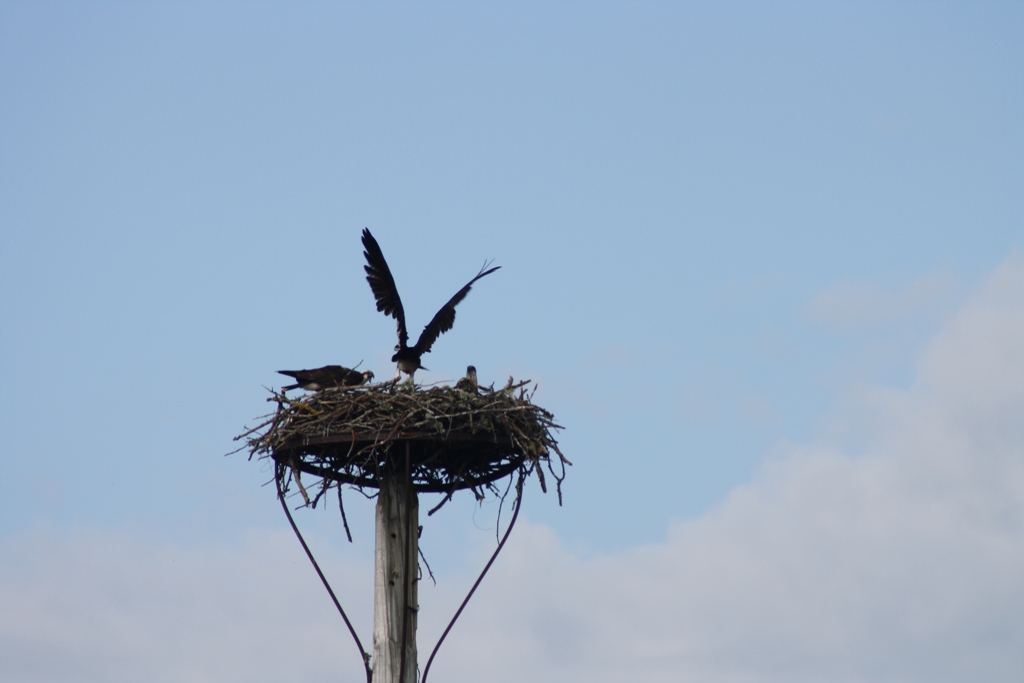
When Your Neighbours Are Fish Hawks

Thanks to the distinctive cries of the ospreys, we know when breakfast, lunch and dinner are arriving:


There are only two babies in the pictures but Dwayne is firm in his sighting of three. Soon they'll be jumping around the nest, from side to side, practicing their wing flaps. The first flight -- it's an amazing moment to witness (three times) and this is the fourth summer we've been lucky enough to see it.