Wednesday, October 23, 2013

Why We Worry At 3 AM...About Cats

First published in The Oxford Journal on Wednesday, October 16, 2013 by Sara Mattinson.

Three o’clock in the morning is Prime Worry Time.  You wake up – and Bam! the brain starts running on its treadmill of worries.  
I Googled “Why do I wake up at 3 am?” to see if there’s a reason for it. Several sources indicate that the middle of the night wake-up call is from the liver, and it’s about stress. Stress causes the adrenal glands to give off adrenaline, which revs up our system with a burst of energy to deal with whatever stressful situation we are facing. 
Now, the liver regenerates in the middle of the night and to do so, it needs glycogen. The problem is that adrenaline uses up glycogen so if there is a lot of stressful situations in your life, your body may not have enough in the glycogen bank when the liver tries to make a withdrawal at 3 am. Instead, the adrenal glands offer up adrenalin instead – and Bam! the brain fires up the treadmill.
And what is fuelling these worries at three o’clock in the morning? Pretty much the same things that cause us to feel stressed out during the day: money, a job, the kids. 
Or in my case, the cat. 
Why would anyone waste Prime Worry Time on a cat? This worry is about life and death and it’s tapped into a major global concern. While it might seem more productive to worry about money, a job, and the kids, worrying about the cat’s hunting habits is just as serious. 
Particularly if this cat has peed on you. 
Three years ago, we took in a year-old female stray cat when she decided a warm house and an easy food supply were more palatable than another winter in the wild. Since we feed birds from multiple feeders around the house, including one attached to the front deck, we made her an indoor cat, a change that didn’t seem to bother her. 
Everything went well until the following November. The combination of a major renovation to the house and the arrival of a puppy made Fern long for the great outdoors. To get this message through to me, she began to pee on our bed. When I couldn’t figure out why, she peed on me. At three o’clock in the morning. Out the door she went and everything has been stress-free ever since.
Unless you are a bird. 
According to a recent national survey by Environment Canada, it is estimated that more than 95 percent of the 268 million birds killed through human activity are victims of cats, power lines, traffic or houses. 
Here’s how that breaks down: Feral cats are estimated to kill 116 million birds a year while domestic cats kill 80 million. Compare that to the next two items on the list – power lines and houses account for 25 million and 22 million bird deaths respectively – and you get an idea of the massive destruction cats are causing to our bird population. 
And that’s just in Canada. The most recent estimates out of the USA suggest American cats kill between 1.4 and 3.7 billion birds a year.
Is it any wonder I wake up at three o’clock in the morning worrying about this? My sweet little tuxedo cat is responsible for the slaughter of at least 40 birds a year. One cat…in a country that is estimated to have eight and a half million domestic cats and upwards of four million feral cats. All because I don’t like being peed on in the middle of the night and there seems little justification for putting a cat down simply because she follows her natural instincts to prey on, and play with, birds and rodents. There has to be a way to enjoy the songbirds without endangering their lives more than power lines and houses already do. 
Luckily, I have discovered a product that may save the birds and my bedding. It’s a colourful ruff-like cloth collar that fits over a breakaway collar – the kind Fern goes out wearing but never comes home with. Apparently, songbirds’ eyes see bright colors as extra bright, making them easily noticed. So Fern can wear the bright collar, the birds can fly to safety and my liver can rejevunate itself with all the glycogen it needs since I won’t be worrying all the time that by feeding the birds, I’m also feeding the cat. 
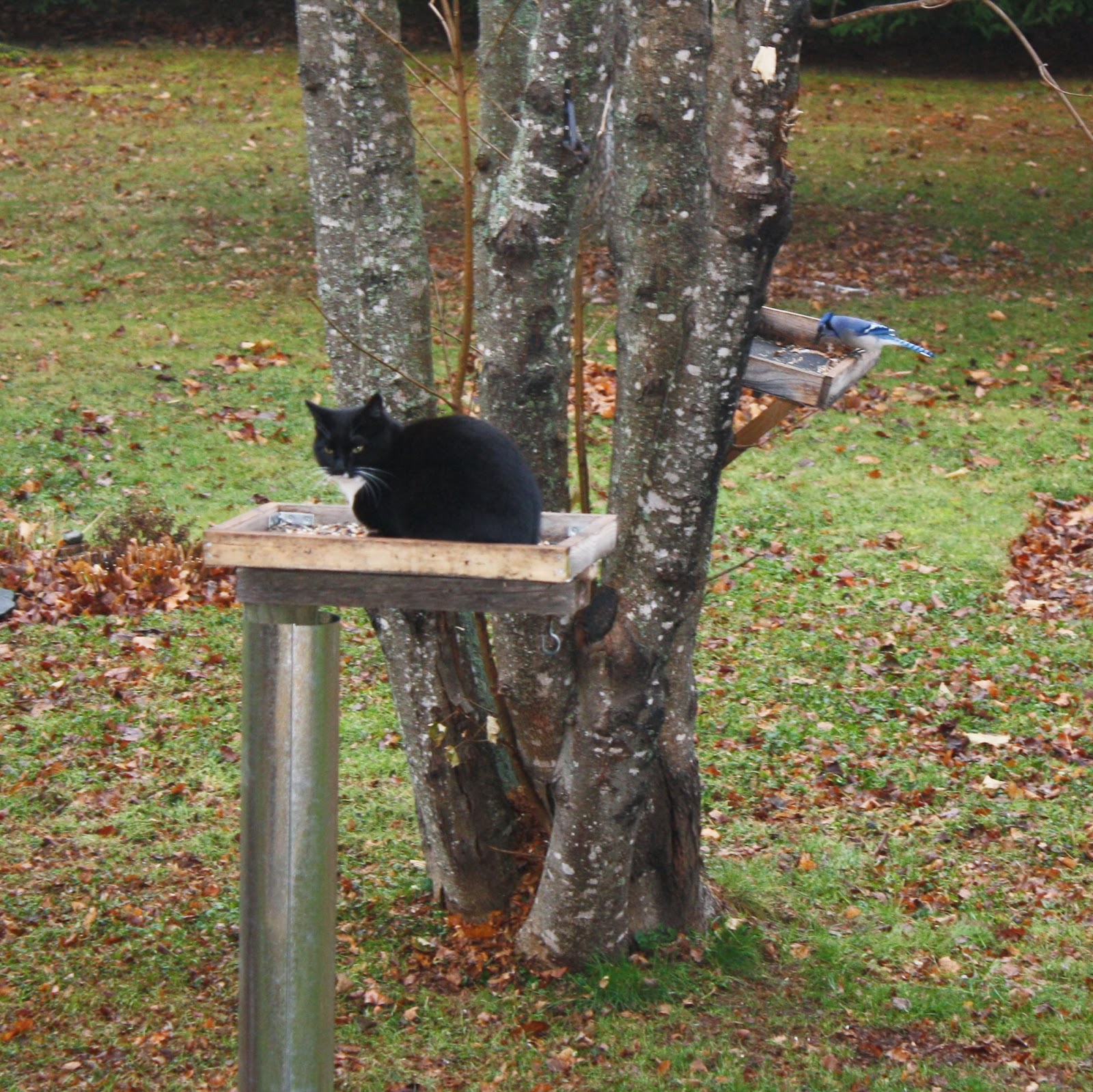
Fern waiting for supper...

Friday, October 18, 2013

A Suitcase, A Notebook And $3 Million

My cousin David, who lives in Toronto, is always posting intriguing questions on social media that make you laugh out loud or think. A few weeks ago, he posed this question:
"For three million dollars, would you blindfold yourself, touch a spot on the globe and live there for three years?"
And for some reason, my immediate gut reaction was "Yes!"
(More surprisingly, that also was my husband's answer but he might have learned to humour my hypothetical questions.)
Most people, however, who answered David's question said No, unequivocably, while others said they'd go IF they could use part of the $3 million to buy flights back home to visit. Likely, if someone gives you millions of dollars to relocate for a certain number of years, ya gotta complete the time to get the moolah.
I like my job and I like my home in the country but the idea of three years in a new place, with new people to meet, new food to try, new stories to hear -- that seduces me. One of the lessons I learned from my father's experience with dementia is that you NEVER KNOW what could happen. Life is too short to not be able to put your finger on the globe -- and go see what stories you can find.
But the fact is I can't just pick up and go, no matter how many millions are at stake, because I have so much stuff weighing me down. Stuff like property and vehicles, dogs and cats and chickens but small stuff too, like a collection of elephant figurines, a delicate hummingbird nest lined with feathers from our hens, 6 pairs of Alegria shoes (could take them with me...) and a hundred or so books.
In the movie, "Up In The Air", George Clooney's character makes a long speech about how everything you own should fit into a knapsack. That stuck in my mind because I can't imagine be that un-rooted but also because I knew he was right. We get buried under stuff and become paralyzed by what to do with it when we want to leave it.
It's sad, a little bit, that stuff holds me back from adventure even though it's living stuff like pets and chickens. I'm sure an unwavering commitment to stuff holds most people back from experiencing more than just their block, that resort, the cottage, the mall. My neighbours, singer/songerwriters Dale Murray and Christina Martin, are spending ten months in Europe. They lock the door of their house behind them and go. Okay, I've heard they have a housesitter but still... I make sure I look at every single photo they post from their travels in Germany and Switzerland.
During university, I remember my mother and I talking about going to Scotland as soon as I'd graduated but the idea didn't stick. Instead, I went to England with my father ten years later, shortly after he'd been diagnosed with dementia, because he'd been diagnosed; that was my first trip overseas. But it was celebrating my 40th birthday in Scotland that gave me this large, swollen, festering bug bite for travel.
And not just because I had found the perfect traveling companion. There's this pull to experience more.
It's interesting that I never craved adventure till, would never have been brave enough to pick any old spot on the globe when I was 25 or 35. I honestly think this temptation stems from two things: The enjoyment and satisfaction I get from the "In Conversation With..." interviews I do for the newspaper, and the fact I've moved very five or six years throughout my life. So many interesting people out there, so many interesting stories to discover.
Plus, I know that book publishers would eat this kind of memoir up! Dare I insist to my husband that we try -- Oh, wait. No one is actually offering three million dollars, are they?
David? David? You could be my patron. I'd dedicate the book to you, cousin.


Paddling down the River Tay, Scotland, May 2010.


Birthday lunch in a sheep pasture with our guide, Biscuit.

Wednesday, October 16, 2013

In Conversation With...Sharon Rector

First published in The Oxford Journal on Wednesday, October 2, 2013, by Sara Mattinson.


If there is one international language, it would be tea. Sharon Rector fills four mugs as we sit down in her kitchen with her two houseguests.
Sharon and her husband, Al, moved to Oxford in 2007 to be closer to one of their sons. 
“We ski at Ski Wentworth and my mother-in-law lived in Great Village and my son, Corey, works at Ski Wentworth so it made sense to move here,” says Sharon, “and I found the old house that I loved.”
But Al passed away in 2012. 
“I’m always saying it’s like the John Lennon song, ‘Life’s what happens when you’re making other plans’,” Sharon says with a shrug. “So now I’m alone.”  
Not quite. Sharon and Al had talked about hosting an international student before he became ill so Sharon carried on with their plan. 
“We thought it would be interesting and we have enough room here and there is a need,” Sharon explains. “Someone had approached us and said they were always looking for host families.”
Sixteen-year-old Yu Fukanaga came to Canada through a school program for good students; she had a choice of either west or east then her choice of province. She arrived in Nova Scotia from Osaka, Japan, last January -- in the middle of a Canadian winter -- and was hosted by a family in Springhill.
“My hometown doesn’t have any snow,” she tells me. “I was so excited for first day. All white! My first day of school was snow day. It was so cold, it was painful,” she laughs. “After a week, I was so snowy.” 
By which she means, she’d had enough.
Allergies prompted a move to a new host family and she arrived at Sharon’s Oxford home at the end of August. She started at Oxford Regional Education Centre last month by herself because Sharon’s other houseguest, 16-year-old Marina Oliviera, had not yet arrived. 
“Everything is sometimes hard,” Yu says. “Chemistry is hard for me. First day of school. Marina wasn’t there, she was still in Brazil. Who can I talk to? Very scared. I don’t know who is good to talk to. I talked to a girl and she was very nice. She eats lunch every day now with us. I was very lucky.”
Yu has been in Canada for 10 months but Marina only arrived September 7; she isn’t as chatty in English as her fellow international student.
“It’s really good,” she says about her first month in Nova Scotia. “When I come, in the first days, it was a little scary but now is okay.”
Marina came to Canada through a government program called ‘Win the World’. 
“They pick the best students in each school and send them to another country to learn more English,” she says. “They choose the country.”
When I ask her what she thinks of Oxford, Marina answers, “It’s really calm. Quiet.”
Sharon jumps in.
“Brazillian people are very flamboyant and demonstrative,” she explains. “We’re more quiet.”

Sharon Rector is flanked by Yu Fukunaga and Marina Oliviera. 
Both girls agree on one overall impression of our area: Everything is big. Which is interesting since the population of Osaka, Japan, is 2.5 million and Marina comes from a town of almost 50,000 people. 
“Osaka has many buildings, it’s all tall,” says Yu. “There are lots of trains. It’s not like Canada. [In Osaka] I can walk ten, 15 minutes but we have stations everywhere. We use cars but my family doesn’t have any cars because we don’t need. Here is so big but so small,” she says. 
And giggles.
Teenaged girls, living in a foreign country and being interviewed for a newspaper, overflow with smiles and giggles. Sharon must be enjoying their company. 
“We went to Frenchie’s. Ah!” Sharon says with a big smile. “Well. The eyes! They love Frenchie’s.
Sharon doesn’t find it difficult to cook for them. 
“They’re not fussy,” she says. “Yu likes to have rice. Now, when I went to my orientation, I was told they’re supposed to experience everything Canadian. But when they’re here this long, I don’t see the harm in making rice for her. Marina wants beans and rice.”
The girls already know their favourite Canadian foods: Yu likes banana bread and Marina likes poutine. Both girls like fish cakes.
When we get talking about food, Yu fingers her iPhone to show some photos of Japanese donuts. 
“Your phone is in Japanese!” I exclaim then turn to Marina. “And your laptop is in...?”
“Portugese,” she replies.
What’s interesting is how many words Yu pronounces the way we do, but with a different inflection or accent.
“Some of the words are the same,” Yu says. “We say keetchen, chocorate, curtans, tabul. All similar. Cam-a-ra. We have many English words as Japanese.”
“What’s the word for tea?”
“We say ‘kotcha’…but we can say tea.  When we go to MacDonald’s, we say, ‘Please want ice tea’. We use lots of English words in our life in Japan.”
I give Marina a new word to learn in anticipation of the coming cold weather: “You’re going to need a toque.”
Both Marina and Yu return to their home countries early next year, after exams. What will they talk about when they get back to Taquaritinga and Osaka?
“Everything is big here,” says Yu. 
The same goes for Marina. 
“Home, we don’t have really big yards,” she says. “Here, we have more space. It’s all green here.”


Tuesday, October 15, 2013

Conference Call

For the past six weeks, I've been consumed by one project: My hour-long presentation at the Alzheimer Society of Nova Scotia's annual conference.
Now the countdown is on...Monday and Tuesday, October 21 and 22 at the Holiday Inn Harbourview, Dartmouth. That's next week!
Me specifically: Monday afternoon at 3 pm. Wow! Won't believe I'm doing it until I'm there.
For the first time, I'm putting my mouth where my words are. This is my first speech about the caregiving experience I shared with my mother. After writing about it for ten years, and the last four being after my father's death, public speaking & presentations are the next logical step for me to take. I'm grateful to the Alzheimer Society of Nova Scotia for giving me this opportunity to change attitudes towards dementia.

I'm nervous but in a good way. More like excited nerves -- finally getting my message out there. Once I was no longer a caregiver, I was able to look back and reflect on the experience and see so many things that I couldn't at the time. Hence the title of my presentation: "I Wish I Knew Then What I Know Now." So much to say, so many stories to share.
The presentation is broken down into three topics: Love, Music and Acceptance. Acceptance -- meaning "It's not about you, it's about the person you need to take care of" -- is the most challenging part to express. Especially in an hour. But I consider it the most important. Attitudes about dementia, about the people living with dementia, must change. Otherwise, we're heading for a big crisis in care. Personally, as a woman with no children and a husband who is 14 years older, I worry about what kind of care I'm going to receive if there is no one to watch out for me.

You can still register for the two-day event. But please note: The "Friends & Family Night" on the evening of Monday, October 21, is FREE! And I'm part of a panel doing a Q&A about living with dementia that evening.
It begins at 6 pm, and the panel runs from 7 until 9.

This is what I know now: Knowledge is power. Fear and ignorance about dementia only makes it harder to take care of someone you love the way they deserve to be taken care of. Come and be empowered -- you never know when you'll need what you learn.

Online: http://www.alzheimer.ca/en/ns/We-can-help/Education/Provincial-conference

Brochure:


Wednesday, October 09, 2013

P.S. I Miss You

First published in The Oxford Journal on Wednesday, October 2, 2013, by Sara Mattinson.


In my favourite photo of my friend Diana and me, we are standing with our arms around each other with her Golden Retriever sitting between us. We look happy because Diana is healthy two months after a surgeon removed cancer from her oesophagus. 
“I’m away having major surgery because I have cancer and what do you do? Fall in love!” Diana said after she’d returned from the hospital and I’d told her what had transpired while she was away from Pugwash Point that summer of 2006. 

October 2006, Pugwash, NS
Our friendship had begun two years earlier with morning dog walks and evening Scrabble games but what I cherished most were our trips to the movie theatre. We went about once a month, to see a “chick flick”. As we made the hour-long trip to the theatre, we chatted about our dogs and husbands, books and country music videos. I told stories about substitute teaching and Diana talked about her three grown children. We laughed a lot. 
 “I’m not much of a chatterbox,” Diana once said to me, “but you don’t seem to notice.”  
It was my way of creating a cancer-free zone for her.  
Six months after my wedding, Diana’s cancer returned and a few weeks before she was to begin radiation treatments in March 2008, we went to see a movie called P.S. I Love You. When the trailer for Mamma Mia had appeared on the screen, I’d leaned over and whispered, “We’re going to see that when it comes out this summer!”  As I sat back, anticipation changed to horror: I’d just made a future date with a woman battling an aggressive cancer. 
Four months later, Diana couldn’t attend our first anniversary party because she was in the hospital, finding out that the reason she couldn’t breathe was the liquid around her heart, which was actually more cancer.  In a card, I thanked her for being such a big part of my happiness then wrote, “As soon as you are having a good day, we must go to the movies.”  
A week later, Diana phoned.  
“I’m having a good day,” she told me. “Let’s go to the movies tonight.”   
Sitting in a dark movie theatre, eating popcorn and watching Mamma Mia, I concentrated on my intense gratitude for this moment, not on the fact that given Diana’s prognosis – two to twenty months to live – there weren’t many more of these evenings to come. 
In early October, I was working at my computer on a Saturday morning when I thought, “I should call Diana and see if she wants to go to a matinee this afternoon.” As I put my hand on the phone receiver, I thought of the deadlines I faced and how much I could get accomplished by staying home so I didn’t call. 
A few hours later, the phone rang.  
“Diana’s gone,” her husband, Matt, said.
A massive heart attack had taken her, quickly, in her own living room. She’d had exactly two months to live. 
Thoughts pinged around my brain: If only I had called her! She might have died in my car! I thought we had more time! Who will I go to the movies with now?
The next morning, my husband suggested we take the ATV for a drive through the wood lot.  
“You can cry whenever you need to,” he said.
When I shoved my hands into the pockets of my jacket to pull out a pair of gloves, I also pulled out a small piece of paper. It was the ticket stub for P.S. I Love You. 
After the funeral, I was wracked with guilt. Why didn’t I visit more? Why didn’t I go over for games of Scrabble? Why didn’t I call that morning? My rational side reminded me that a weakened heart made her tired, medication made her groggy. I remembered how laughing made her cough which made her gag. I remembered that Matt and Diana had been at our place for supper just two weeks before she died.  
“You were a good friend,” my husband assured me. “You went to the movies all the time.”
Now that Diana was gone, it wasn’t enough.  
Two weeks after the funeral, I stopped at the bank machine in Pugwash and when I reached out to shove my card into the slot, there was a small white piece of paper wedged under my palm.
It was the ticket stub for Mamma Mia.   
I’d used this card many times since we’d seen that movie in August and I certainly wasn’t wearing this sweater coat then. I had no idea where that stub came from, didn’t even recall keeping it. It simply appeared in my hand on a day when I was missing Diana and wanting to drive to her house for a cup of tea and wishing for the millionth time I’d been a better friend.  
My friend Diana Roach died five years ago this month. I still have those two movie ticket stubs, tucked in a picture frame with that favourite photo, as a reminder that sometimes, just doing one special thing is enough.

Sunday, October 06, 2013

A Country Kind of Day

My first few years in rural Nova Scotia were idyllic. As I settled in to a new house and a new neighbourhood, and spent some time substitute teaching throughout the school year, I had lots of time for reading and writing, gardening, raising chickens, walking and exploring.
Idyllic.
After six years, those slow, peaceful, book-filled days seem like distant memories. Most of the writing I do these days are for the columns in the newspaper and most of the exploring I do is on the Internet. Shame, shame!
It's a great lesson in "be careful what you wish for"! because I wanted to write full-time...I just forgot to add, "at home" where I could keep reading and gardening and walking. So between writing 140-character tweets, posting short essays on Facebook, and creating my presentation for the Alzheimer Society of Nova Scotia's conference in two weeks (two weeks! wow), I've been too busy for creative writing.
Sometimes I feel like something is missing from my life, something important, something fundamental. Like my writing hand has been cut off or the creative part of my brain has shut down. It's a spooky feeling. It's a lonely feeling.
But autumn has a way of drawing me out of the office, out of my mind (so to speak). Being on the back of the bike, riding through the woods, hanging out at the Ducks Unlimited duck pond has a way of relaxing the brain and body and reminding me of what I love so much about living in the country. And living with a Nova Scotia country boy.
Breathing space. Creative space.
October in rural Nova Scotia is good for the soul.


Wednesday, October 02, 2013

In Conversation With...Jane Jorgensen

First published in The Oxford Journal on Wednesday, September 25, 2013, by Sara Mattinson.


When Jane Jorgensen started thinking about life after nursing, she knew one thing: “I wasn’t going to be one of those people who sat and twiddled their thumbs and felt sad.”
Jane, who retired last November at the age of 58, graduated from Acadia University in 1976 intending to be a teacher but the pull to be a nurse was stronger (her mother was a nurse in Amherst) and she trained at the Aberdeen School of Nursing in New Glasgow. Working as a critical care nurse in Amherst, as a manager of staff training and development at the Sunset Community, and finally as a nurse supervisor at East Cumberland Lodge, Jane managed to combine both her passions.
But don’t think she gave up teaching and nursing in retirement; she’s just changed her clientele. 
“About five years before I knew I was going to retire, I started to plan on those things I’d always wanted to do. Driving horses, having bees, and having a boarding kennel.”
Because she and her husband, Gordon, used to run a dairy farm (health problems forced them into easier-to-handle livestock like sheep and llamas), they were able to convert the former dairy barn into dog kennels because it has concrete floors and is insulated; the former milk room is perfect for a grooming salon.
The kennel allowed Jane to indulge in another passion: rescue. 


“We always had dogs that nobody wanted, that were abused or people threw away,” she says. “We love animals and we like being with them. I think I could make a pet out of anything.”
As dogs bark in the kennel behind her and Gordon plays with five newly-arrived puppies in the yard, Jane reveals her motivation for rescue. 
“I cannot understand people who don’t look at animals as living, important beings. There are lots of people in this world who think of animals as a commodity or product or thing and that’s a mindset I cannot understand. I cannot understand why people don’t get that dogs have the same thoughts and feelings we have and if we don’t take care of them, well, that’s wrong,” she says. “Some of those people are going to go to hell and it’s for some things that are a real crime against animals.”
Jane and Gordon have seven pet dogs of their own and a collection of cats, but with a kennel of nine runs, Jane was able to offer her services to the Litters ‘N’ Critters Animal Rescue group. 
“It’s a group of people who now focus on the northern dogs; we partner with the Happy Valley/Goose Bay SPCA [in Labrador]. Not to say that we don’t take dogs from all over because we do. We had a mum and her 11 pups from Sydney last year.”
Why are these northern dogs so urgent?
“There’s no vet care, they can’t get their dogs spayed or vaccinated,” Jane explains. “The Happy Valley/Goose Bay SPCA has a shelter that is half the size of my kennels. And the violence is unbelievable. And I’ve had dogs here that are the only ones who survived out of litters that froze to death.”
When the situation reached a crisis last year at the shelter in Happy Valley/Goose Bay, Jane was one of several volunteers who received Labrador dogs in a massive FedEx Canada delivery by plane. 
“We got three bitches,” says Jane. “One had six pups, one whelped the next day and one whelped on the first of July. The dogs weren’t used to being fed. One didn’t know what kibble was. They were eating 21 cups of kibble a day between the three of them.”
The cost of feeding these dogs was overwhelming.
 “I called Steve at the Co-op and asked if he had any broken bags of kibble he could give me at a discount price. He said he’d look into it. Well, they brought us almost 2,000 pounds of dog food. Co-op Atlantic gave us dog food, cat food and lab animal food.”
The food arrived as dramatically as the dogs: Harrison’s brought it to Jane’s home on Wallace Bay Road on a boom truck.
“They just came and delivered it,” Jane says. “And we’re still feeding the dogs from that. It was amazing. What a wonderful thing that was.”
(The cat food went to Marilyn Williams and the lab animal food went to Hope For Wildlife.) 
Jane estimates that since she first started taking in rescue dogs in 2010, over 100 puppies and dogs have passed through her life. 
“I get the chance to have all these puppies and not have to keep them. And Gordon has the chance for me to satisfy all this fur and I don’t say ‘We’re keeping them.’ I don’t have a hard time placing them but sometimes I have a hard time letting them go.”
Socializing is  big part of Jane’s work in order to find homes for the dogs. The adult dogs that come from Labrador don’t speak English and some have never been inside a home. 
“Many of them have never been handled or  socialized but they’re quick learners. One thing here, because of the kennel, they learn really fast to be housetrained. It’s natural to keep their inside clean. We go out, we come in. They learn that when they do that, they get treats.”
It’s only Jane and Gordon doing all the work and it’s 24/7 but the rewards are huge. 
“I’ve never seen dogs so forgiving and so loving,” Jane says. “The temperament of these dogs is unbelievable. We had a dog here a couple of years ago, he was beautiful. He was big, he was blond, he had blue eyes. He was gorgeous. He had been wrapped in barbed wire and stabbed with a barbecue fork 16 times and thrown away. Somehow he crawled to rescue and they shipped him down here. The only thing I found that made him nervous was the sound of a steel dish hitting the cement; he would cringe. He was the most loving dog; he loved everybody. He was adopted by a family with children and he’s the star of the show.”
Jane leans back in her chair and crosses her arms. 
“We need to take a lesson from them.”